
What Size Kickstand for a Kids Bike? (12, 14, 16, 18, 20 Inch)
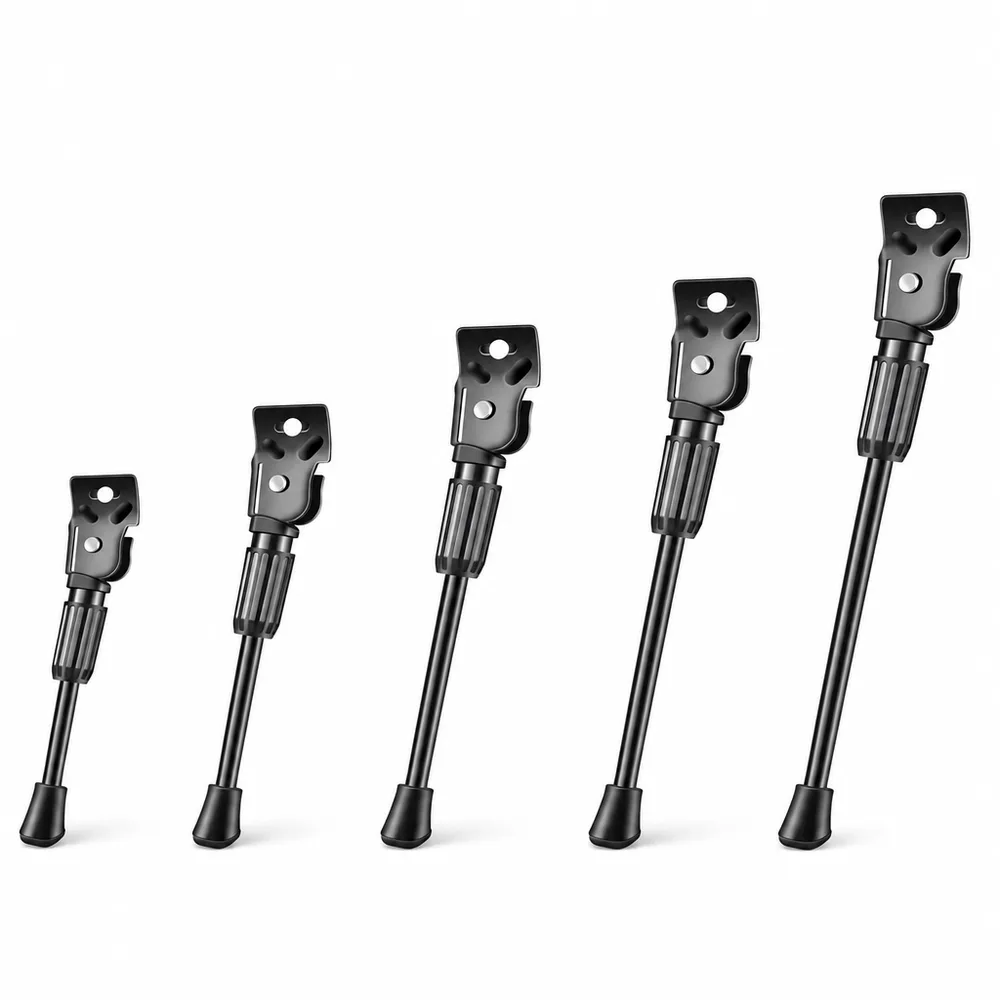
A kickstand is one of those parts nobody thinks about until it is wrong. Buy one that is half an inch too long and the bike leans so far upright that a light nudge sends it over the other way. Buy one that is half an inch too short and the bike leans past its balance point and slides down the wall of the garage. Neither failure looks dramatic in a photo, but a six-year-old who has watched a bike fall on the driveway three times in a row stops trusting the kickstand and just drops the bike in the grass again.
The reason this happens so often on children's bikes is that the whole category is built around wheel diameter rather than frame geometry. Adult bikes are sold in centimeters of seat tube. Kids bikes are sold as "a 16 inch." Two 16 inch bikes from different factories can sit at noticeably different heights depending on tire volume, bottom bracket drop and how much clearance the designer left at the chainstay. That variation is small in absolute terms, but a kickstand is a lever, and small differences at the mounting point turn into visible differences in lean angle at the ground.
Kickstand length by wheel size
The table below matches each wheel size to its kickstand length. Read it as a starting point rather than a law: the wheel size is the single best predictor of the right kickstand length, but it is not the only variable, and the sections further down explain what to do when a bike does not behave the way the chart says it should.
| Wheel size | Kickstand length | Weight | Typical rider |
|---|---|---|---|
| 12 in | 7.3 in (18.5 cm) | 4.9 oz (139 g) | First pedal bikes and most balance bikes |
| 14 in | 8.1 in (20.5 cm) | 5.1 oz (144 g) | Roughly ages 3 to 5 |
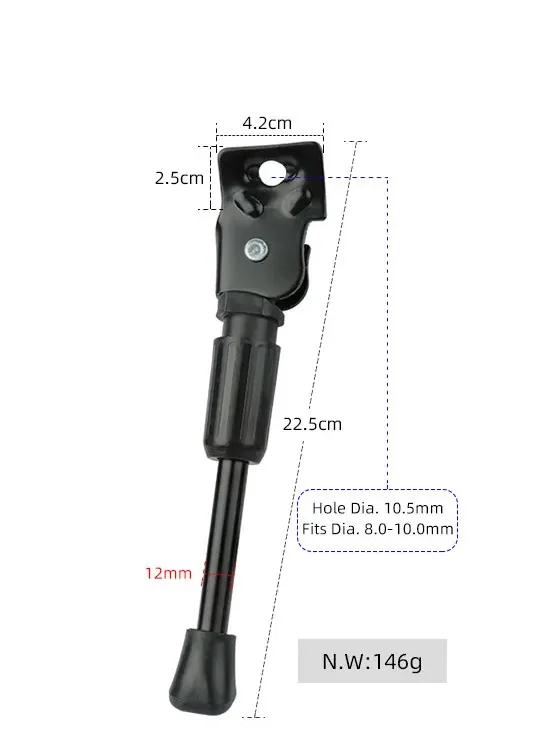
| 16 in | 8.9 in (22.5 cm) | 5.2 oz (146 g) | The most common size in the US |
| 18 in | 10.0 in (25.5 cm) | 5.5 oz (155 g) | The in-between size, roughly ages 5 to 7 |
| 20 in | 11.0 in (28 cm) | 5.6 oz (159 g) | Kids mountain bikes and BMX |
Every length shares the same mounting plate: 0.98 x 1.65 in (2.5 x 4.2 cm), 3 mm thick, with a 0.41 in (10.5 mm) mounting hole that takes a standard kickstand bolt of 0.31 to 0.39 in (8.0 to 10.0 mm). Only the leg length changes from one size to the next, which is why a longer stand weighs a fraction of an ounce more than a shorter one.
Kickstand lengths cover the entire 12 to 20 inch wheel range, from 7.3 in to 11.0 in
— Kickaroo product specification, 2026
How to measure your child's wheel
Start with the sidewall because it removes all guesswork. Turn the bike so the printing faces you and rotate the wheel slowly. The marking is usually molded into the rubber near the rim in raised letters, and it survives long after a painted logo has scrubbed off. The first number in the pair is the nominal wheel diameter, and that is the number the entire kids bike industry sizes around.
If the tire has been replaced with an unmarked one, or the molding has worn flat, measure instead. Stand the bike upright, put the end of a tape measure on the ground directly under the rear axle, and read the height at the very top of the tire. That gives you the outside diameter of the wheel with the tire inflated, which lands within a fraction of an inch of the nominal size. A wheel that measures a shade over 16 inches is a 16. A wheel that measures a shade over 20 is a 20. Do not measure the rim on its own, because the rim is roughly two inches smaller than the size the bike is sold as, and that mistake is the fastest way to order a stand two sizes short.
One more check worth thirty seconds: inflate the tires first. A soft rear tire drops the whole back end of the bike, and it is entirely possible to measure a 16 inch wheel as something closer to 15 simply because it has been sitting flat in the shed since last summer.
What to do if you are between two sizes
This is the single most useful rule in the whole guide, and it comes straight out of what buyers report rather than out of theory. A kickstand works by holding the bike at a lean angle where gravity pulls the frame back down onto the leg. As long as the bike is leaning toward the stand, the stand is loaded and stable. Once a stand is long enough to push the bike upright or past upright, gravity starts pulling the frame away from the leg instead, and the bike becomes a coin balanced on its edge.
A few situations put you between sizes even when you know the wheel diameter exactly. Fat balloon tires on a 16 inch bike raise the frame by nearly half an inch compared to skinny tires on the same rims. A rear rack, a trailer hitch or a bolt-on wheel guard can move the only usable mounting point back along the chainstay, which changes the effective geometry. Some 18 inch bikes are built on frames that started life as 20 inch designs and sit higher than their wheel size suggests.
Two practical fallbacks exist when the shorter stand still is not right. The leg tube is steel, so it can be shortened with a hacksaw or a pipe cutter, and several buyers have done exactly that. It is a permanent change and it removes the rubber foot temporarily, so it is a last resort rather than a plan. The other fallback is moving the mounting plate: sliding the plate a centimeter forward or back along the chainstay changes the lean angle slightly without touching the leg at all. The step-by-step installation guide covers that adjustment in detail.
Three real sizing cases from buyer notes
Written buyer notes that mention kickstand length or fit rather than build quality
— Kickaroo buyer feedback, 2026
The first case is the most instructive, because the buyer solved the problem before it happened. Fitting a kids mountain bike with 20 inch wheels, they read the existing feedback, concluded the 20 inch stand would sit too tall for their particular frame, and ordered the 18 inch instead. In their words: "Got the 18" kickstand for 20" kid's mountain bike and worked fine since some reviews said it was too long (sizing is tricky to gauge but i knew 20" would be too long)." That is the sizing-down rule applied by a buyer who had never seen this guide.
The second case runs the other way. On a 12 inch frame, measure from the chainstay bracket down to the ground before ordering: bikes at that size vary more than any other, and the 7.3 in stand is sized for the shortest of them. If your measurement lands between two lengths, take the shorter one — a stand slightly under leans the bike a little further and holds just as weltforward, but it also tells you the 12 inch end of the range is where frames vary most.
The third case needs no analysis at all. A buyer ordered a size, fitted it, and discovered it did not match the bike. It happens often enough that the wheel size is printed on the tire in the first place. If you are unsure after reading this, the fastest route is to send a photo of the rear of the bike through the contact page before ordering rather than after.
You can read the rest of the buyer notes, including the photos people attached, on the reviews page.
12 inch: the size that causes the most trouble
A 12 inch bike is a strange object mechanically. The wheels are tiny, the bottom bracket sits close to the ground, and the whole frame is designed so a three-year-old can put both feet flat on the pavement while seated. Manufacturers achieve that in different ways. Some drop the bottom bracket, some shorten the head tube, some use tires barely wider than a thumb. The result is that two bikes described identically as 12 inch can differ by nearly an inch in how high the chainstay sits above the ground, and an inch is a lot when the stand itself is only 7.3 in long.
Practically, this means two things. If your 12 inch bike is a low, wide, toddler-focused design, expect the stand to lean the bike at a shallow angle, which is exactly what you want. If it is one of the taller 12 inch bikes with knobby tires, expect to either accept a very upright lean or to shorten the tube. One buyer fitting a balance bike put it plainly: they wanted the bike to stay standing at the bike park rather than lying in the dirt, and it did.
Balance bikes deserve a note of their own. Many of them have no chainstay at all in the conventional sense, because there is no drivetrain, and the rear triangle is a single flat plate or a pair of thin stays. Check that there is a flat section at least as wide as the 0.98 in mounting plate before ordering, and check that a bolt can pass through it.
14 and 16 inch: the easy middle
This is the volume part of the kids bike market in the United States, and standardization follows volume. A 16 inch bike is the first bike most American children ride without training wheels, so there are more of them in circulation than any other size, and the frames have converged on similar proportions. Buyers fitting these sizes tend to write about how quickly the bike went from lying on the lawn to standing by the door, not about geometry.
One buyer fitting a European 14 inch bike reported that it "fits perfectly for the Btwin 14" bike," which is worth knowing if you have a bike bought overseas or secondhand from a brand that is not sold in US stores. Wheel size is an international standard even when frame naming is not.
The 16 inch length has its own dedicated page with the full specification, the buyer photos for that size and the fitting notes: see the 16 inch bike kickstand page.
18 and 20 inch: when a kids bike behaves like an adult bike
An 18 inch bike is often the same frame family as a 20 inch with smaller wheels, which is why the 18 inch stand sometimes fits a 20 inch bike, as the buyer quoted earlier found. It is also the point where kids bikes start carrying features borrowed from adult bikes: rear disc brakes with a caliper mounted on the chainstay, a short suspension linkage, or an aggressively shaped tube that has no flat area for a plate to sit against.
Before ordering either of these two lengths, look at the rear triangle and find a flat section on the chainstay behind the bottom bracket. If a disc brake caliper occupies that space, the stand may have to move outboard of the caliper or forward toward the crank. One buyer working on a 20 inch bike had to mount the plate on the inner face of the stay because a welded lump on the outer face was in the way, and it worked fine.
The 20 inch length also covers BMX-style bikes and kids mountain bikes; details and buyer photos for that length live on the 20 inch bike kickstand page. If the bike in question is a genuine mountain bike rather than a kids bike with knobby tires, read the mountain bike kickstand guide first, because adult trail bikes are a different problem entirely.
Where the kickstand actually bolts on
This matters for sizing because the plate position is your last adjustment. Mounting it closer to the bottom bracket sets the leg further forward and effectively shortens its reach, while mounting it back toward the axle does the opposite. It is a small adjustment, but a small adjustment is often all a borderline fit needs.
The missing bolt is the detail buyers mention most after sizing, and it is worth saying plainly here so nobody is surprised when the package arrives. The installation guide covers the hole size, the sequence, and how to keep the bolt from working loose over a season of riding.
Short answers to the questions we get most
Should I size up or size down when I am unsure?
Size down. A slightly short stand leans the bike further over and still holds it. A slightly long stand pushes the bike toward vertical, and a bike that passes vertical falls.
Can I adjust the length after it is fitted?
No. Each Kickaroo stand is a single fixed length matched to one wheel size, which is what makes it rigid. The trade-offs between fixed and telescoping designs are laid out in the adjustable versus fixed comparison.
Does a bike with training wheels need a kickstand?
Not while the training wheels are on, because they hold the bike upright already. The moment they come off, the bike has nowhere to rest. Several buyers fit a kickstand on the same afternoon they remove the training wheels. The wider question is covered in do kids bikes need kickstands.
What about balance bikes and scooters?
Both can work if there is a flat section with a bolt hole in the rear frame. Buyers have fitted the 14 inch length to a balance bike and the 20 inch length to a heavy electric scooter. Match the stand to the height of the frame rather than to any printed wheel size in those cases.
Average across 416 verified buyer ratings for the Kickaroo kids bike kickstand
— Kickaroo verified buyer ratings, 2026
Picking your length in one line
More guides are collected on the blog index, and delivery timing is on the shipping page.
Order the length that matches the wheel
One kickstand, five lengths, one price. Free shipping and a 30-day money-back guarantee if the fit is not right.
See the kickstand and pick your size