
Adjustable vs Fixed Bike Kickstands: Which One for Your Bike?
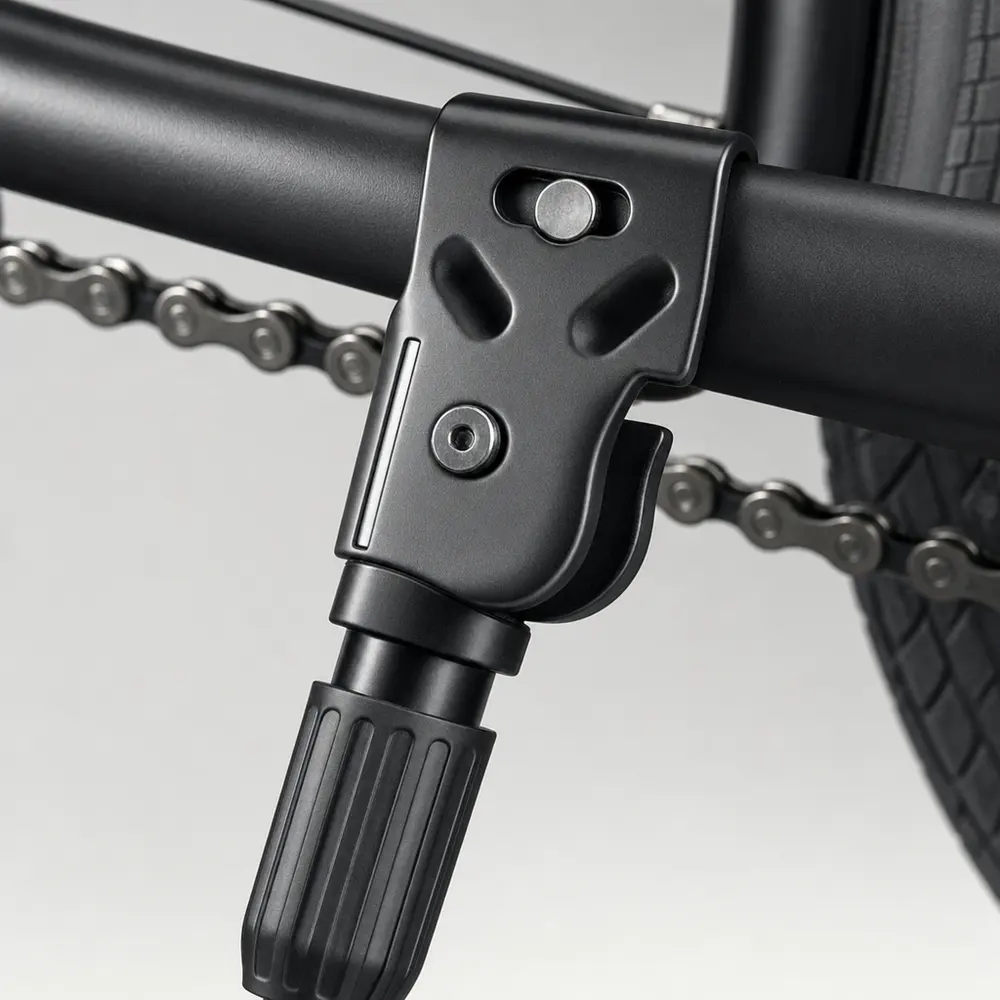
Every mechanical part that adjusts has bought that adjustment with something. A telescoping tent pole packs smaller and flexes more than a solid one. A wrench with a sliding jaw fits more nuts and rounds more of them. This is not a criticism of adjustable things, it is simply what a joint does: it introduces a place where two pieces meet, and the connection between them is now something that has to be maintained rather than something that is simply true.
Bike kickstands sit squarely in that trade-off. Some are made from a single piece of tube with a foot on the end. Others are made from two tubes with a collar between them, so the same part can serve a wide range of frame heights. Both designs are common, both are sold in large numbers, and the useful comparison is not which one is better in the abstract but which set of compromises fits the bike you are actually working on.
Kickaroo sells both designs. The Kickaroo kids range is fixed length: five steel stands, one per wheel size, from 12 to 20 inch wheels. The Kickaroo adult range is adjustable: one aluminum alloy stand with a leg you set on the bike, covering 20 to 29 inch wheels in two ranges. The design follows the bike, and below is the reasoning behind that split.
What each design actually is
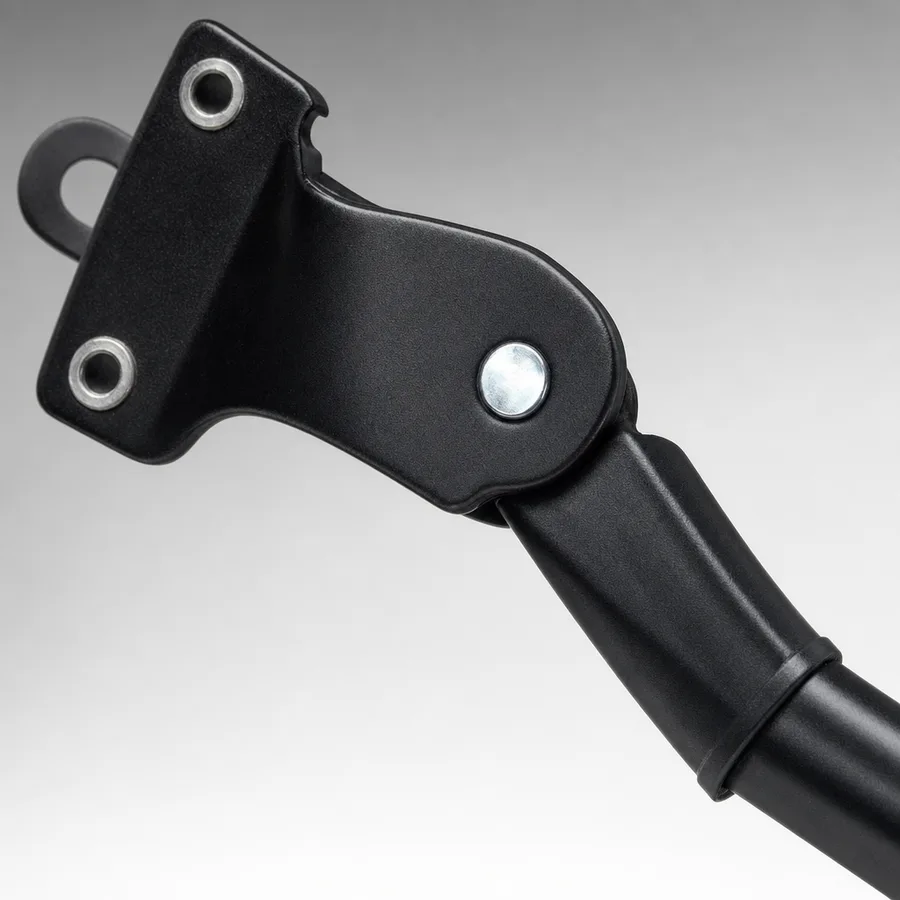
The mounting end is identical in concept across both designs, which is why the choice is genuinely about the leg and nothing else. A plate sits against the chainstay, one bolt passes through it, and the leg pivots on a spring-loaded hinge so it folds out of the way when the bike is moving. Change the leg from one tube to two and everything above the pivot stays the same.
There is a third design that gets confused with these two, and it is worth naming so you can rule it out quickly. A center-mount stand bolts under the bottom bracket rather than on the side of the chainstay, and it usually has a much longer, heavier leg. It is common on cargo bikes and delivery bikes and rare on children's bikes, because most kids frames have no plate under the bottom bracket to clamp to.
What a telescoping joint costs you
The play comes from clearance. For an inner tube to slide inside an outer tube, it has to be smaller than the bore, and that gap is what lets the leg rock slightly when the bike is nudged. A good clamp closes most of it. A worn or lightly tightened clamp does not, and the symptom is a bike that seems stable until someone leans on the saddle.
The clamp itself is a maintenance item on a part that otherwise has none. Grit works into the joint from wet pavement, the collar loses its grip on the inner tube, and the leg slowly collapses under load rather than holding. This is a slow failure rather than a sudden one, which is precisely why it goes unnoticed until the bike ends up on the ground.
The weight is small in absolute terms but real. On an adult bike nobody would notice a couple of extra ounces. On a child's 16 inch bike, weight is the argument people make most often against fitting any kickstand at all, and it is discussed in the piece on whether kids bikes need kickstands.
Why a fixed length is stiffer
Number of pieces in the leg of a fixed-length kickstand, compared with two tubes and a clamp on a telescoping design
— Kickaroo product specification, 2026
The practical version of this shows up in how the bike behaves when something bumps it. A stiff leg holds the lean angle you set during installation, so a knock moves the bike and the bike comes back. A leg with play at a joint lets the bike move first and the frame follow, and on a shallow lean that extra movement is sometimes enough to take the bike past its balance point.
That is exactly the trade being made: you give up the dial, and you get a part with nothing to slip. On a kids bike parked and knocked over a dozen times a week, a fixed leg has no adjustment to work loose — which is why the five lengths exist in the first place.
The other quiet advantage is that there is nothing to check. The entire maintenance schedule for a fixed stand is the mounting bolt, and the installation guide covers keeping that bolt tight with a lock nut or threadlocker. On an adjustable stand you are checking the mounting bolt and the clamp.
The cost of a fixed length
Written buyer notes that concern kickstand length or fit rather than build quality
— Kickaroo buyer feedback, 2026
That number is the strongest argument an adjustable stand has. When a design has no adjustment, the sizing decision has to be right the first time, and a proportion of buyers will get it wrong. Some of them shorten the tube with a hacksaw, which works because the leg is steel, and some of them exchange it.
Two things reduce that risk to something manageable. The first is that wheel size is a genuinely good predictor: the length is chosen against the number printed on the tire sidewall, not against a guess. The second is the rule that resolves the borderline cases, which is to take the shorter of two lengths when a bike sits between them. Both are set out in the sizing guide, along with the buyer who deliberately ordered an 18 inch stand for a 20 inch bike and reported that it worked.
The third mitigation is commercial rather than mechanical. Free shipping and a 30-day money-back guarantee mean a wrong length is an inconvenience rather than a loss, and the terms are on the refund page.
When an adjustable stand is the right call
The first case is adult bikes, and it is the reason our own adult range is adjustable. A 29 inch hardtail, a 26 inch hybrid and a 20 inch folding commuter differ not just in wheel diameter but in bottom bracket height, chainstay angle and how far the frame sits off the ground. Publishing a fixed length for each of those combinations would mean dozens of parts, most of which would still be wrong. A leg you set on the bike solves it in one part per wheel range.
The second case is a bike you cannot size confidently. A frame passed down through three families with replaced tires and no legible sidewall markings is exactly that, and measuring at the rear axle only tells you the wheel diameter, not how the frame sits. If you would rather set the leg until the bike stands right than measure first, an adjustable stand is the recommendation.
The third case is anything unusual. Trailers, trikes, cargo frames, home-modified bikes and electric scooters do not follow the wheel-size logic that kids bikes follow. One buyer did fit our 20 inch kids length to a heavy electric scooter and reported it working, but that was a fortunate match rather than a designed fit, and we would not present it as a recommendation.
The fourth case is a household with several bikes of different sizes and one stand that migrates between them. A fixed length that suits a 16 inch bike will be short on a 20 inch bike, and no amount of moving the plate closes that gap. If the stand has to be shared, buy the design that can be reset.
Side by side
| Adjustable (telescoping) | Fixed length | |
|---|---|---|
| How the height is set | A collar or a pinch bolt clamps an inner tube inside an outer tube | The leg is cut to one length at the factory and never changes |
| Parts in the leg | Two tubes, a clamp and its fastener | One tube |
| Stiffness under a side load | Depends on how tightly the clamp holds the inner tube | Set by the tube itself, with no joint to move |
| If you get the sizing wrong | Turn the collar and try again | You need a different length, or a hacksaw |
| Long-term maintenance | Check the clamp; grit in the joint makes it slip | Check the mounting bolt and nothing else |
| Weight | Higher, because of the second tube and the clamp. The Kickaroo adult stand weighs 14.0 oz (0.397 kg) | Lower, between 4.9 and 5.6 oz depending on length |
| Wheel sizes one part can cover | A whole range. The Kickaroo adult stand covers 20-22 in or 24-29 in | One. Each Kickaroo kids length serves a single wheel size |
| Suits best | Adult frames, unknown frames, odd machines, one stand across several bikes | A known wheel size on a child’s bike that gets used daily |
| What Kickaroo sells | The adult stand, aluminum alloy, 20 to 29 in wheels, $29.95 | The kids range, five steel lengths for 12 to 20 in wheels, $24.95 |
Where the two Kickaroo ranges sit
Fixed kids leg lengths, from 7.3 in for a 12 inch wheel to 11.0 in for a 20 inch wheel
— Kickaroo product specification, 2026
The reasoning behind the kids side is the one set out above rather than a manufacturing shortcut. On a child's bike the load is small, the frame is small, and the stand has to survive being kicked out and stamped on several times a day by someone who is not being gentle. A single tube with no joint handles that with nothing to check, and the weight stays between 4.9 oz for the shortest length and 5.6 oz for the longest. The trade is that you have to order the right length: the sizing guide covers every wheel size, and the 16 inch and 20 inch lengths have pages of their own.
Wheel range the adjustable adult stand covers, split into S for 20-22 in and M for 24-29 in
— Kickaroo product specification, 2026
The adult side runs the other way for the reason given in the section above: adult frames vary too much for fixed lengths to be practical. That stand weighs 14.0 oz (0.397 kg), comes in three mounting patterns so it can bolt to a two-hole bracket, a three-hole bracket or under the bottom bracket, and ships with two Allen keys. What you take on in exchange is the joint. Keep it clean, keep it tight, and check it the way you would check any clamp on a bike. A buyer running a 20 inch folding bike described it as long enough on the maximum elongated leg, which is the adjustment doing precisely what it is there for. Buyer photos across the kids lengths are on the reviews page.
How to decide in two questions
Most parents fitting a stand to a child's bike answer both questions without thinking about it, because the tire says 16 and the bike belongs to one child. That is the case a fixed-length design is built for, and it is the case where a telescoping joint is paying maintenance for flexibility nobody is going to use.
On an adult bike the answer flips. Even if you know the wheel size exactly, the frame height around that wheel is not something you can look up, so the leg has to be set on the bike. A grandparent's house with three visiting bikes of different sizes, a swap-meet bike with no markings left on the tires, or a machine that is not really a bicycle at all point the same way. In every one of those cases the adjustable stand is the one to buy, and it is now on this site rather than somewhere else.
Average across 416 verified buyer ratings on the kids range and 1,099 on the adult range
— Kickaroo verified buyer ratings, 2026
More guides are collected on the blog index, including the mountain bike kickstand guide, which covers which adult frames can take a stand at all. The author is introduced on the about page. If you have a frame that does not fit either category cleanly, send a photo through the contact page.
Fixed for kids bikes, adjustable for adult bikes
Five fixed lengths for 12 to 20 inch wheels at $24.95, and the adjustable aluminum stand for 20 to 29 inch wheels at $29.95. Free shipping and a 30-day money-back guarantee on both.
See both ranges and pick your size